
Greetings Matriculants today we look at the monopoly market.
Firstly, we will describe what a monopoly is and then continue with discussing other aspects of it. Under this topic there are two feasible essays which are based on explaining in detail what the monopoly is with or without diagrams.
MONOPOLY
– A monopoly exists when there is only one seller of a good or service for which there is no close substitute.
– A market structure characterized by a single seller, selling a unique product in the market. In a monopoly market, the seller faces no competition, as he is the sole seller of goods with no close substitute. … He enjoys the power of setting the price for his goods.
– A monopoly exists when a specific person or enterprise is the only supplier of a particular commodity. This contrasts with a monopsony which relates to a single entity’s control of a market to purchase a good or service, and with oligopoly which consists of a few sellers dominating a market.
– A monopolist is an individual, group or company that controls all of the market for a particular good or service. A monopolist probably also believes in policies that favor monopolies since it gives them greater power. A monopolist has little incentive to improve their product because customers have no alternatives. Instead, their motivation is focused on protecting the monopoly.
– Monopolies exists when a monopolist becomes the only supplier of a particular product or service. This is different from a monopsony, which refers to a single entity’s sole power to purchase a good or service. It is also different from an oligopoly , which consists of a few sellers dominating a market.
GOOD EXAMPLES OF MONOPOLY
● Eskom
● DStv
CHARACTERISTICS
● A Lack Of Substitutes
One firm producing a good without close substitutes. The product is often unique. Example: When Apple started producing the iPad, it arguably had a monopoly over the tablet market.
● Barriers To Entry
There are significant barriers to entry set up by the monopolist. If new firms enter the industry, the monopolist will not have complete control of a firm on the supply. This implies that under monopoly there is no difference between a firm and an industry.
● Competition
There are no close competitors in the market for that product.
● Price Maker
/Price Setter
The monopolist decides the price of the product, since it has the market power. This makes the monopolist a price maker.
● Profits
While a monopolist can maintain supernormal profits in the long run, it doesn’t necessarily make profits. A monopolist can be a loss making or revenue maximizing too.
This is not possible under perfect competition because If abnormal profits are available in the long run, other firms will enter the competition with the result abnormal profits will be eliminated.
Monopoly losses in Short Run can be triggered by the high costs and the unpopularity of the product.
– The monopoly makes Abnormal/Economic/Supernormal profit in the short run and Long run because it faces no competitors in the long run ( no new firms enter the market ).
ADVANTAGES & DISADVANTAGES OF MONOPOLY
PROS
1. Stability Of Prices
:
In a monopoly market structure the prices are pretty stable. This is because there is only one firm involved in the market that sets the prices since there is no competing product. In other types of market structures prices are not stable and tend to be elastic as a result of the competition.
2. Economies of Scale
:
Since there is a single seller in the market it leads to economics of scale because big scale production which lowers the cost per unit for the seller. The seller may pass this benefit down to the consumer in terms of a lower price.
3. Research and Development
:
Since the monopolist is making
abnormal or supernormal profits, the firm can invest that money into research and development. Customers may get better a quality product at reduced price leading to enhanced consumer surplus and satisfaction.
CONS
1. Higher prices
The monopolist could set a very high price for the product leading to exploitation of consumers as they have no option but to buy it from seller due to the lack of competition in the market.
2. Price discrimination
Monopolists can sometimes use price discrimination, where they charge different prices on the same product for different consumers. This depends on market conditions.
3. Inferior goods and services
The lack of competition may cause the monopoly firm to produce inferior goods and services because they know the goods will sell.
TYPES OF MONOPOLY
1. Simple Monopoly and Discriminating Monopoly :
A simple monopoly firm charges a uniform price for its output sold to all the buyers. While a discriminating monopoly firm charges different prices for the same product to different buyers. A simple monopoly operates in a single market a discriminating monopoly operates in more than one market.
2. Pure Monopoly and Imperfect Monopoly:
Pure monopoly is that type of monopoly in which a single firm which controls the supply of a commodity which has no substitutes not even a remote one. It possesses an absolute Monopoly power. Such a Monopoly is very rare. While imperfect monopoly means a limited degree of Monopoly. It refers to a single firm which produces a commodity having no close substitutes. The degree of Monopoly is less than perfect in this case and it relates to the availability of the closeness of a substitute. In practice, there are many cases of such imperfect monopoly.
3. Natural Monopoly:
When a Monopoly is established due to natural causes then it is called natural monopoly. To-day India has got Monopoly in mica production and Canada has got Monopoly in nickel production. These Monopoly natures has provided to these countries.
4. Legal Monopoly:
When anybody receives or acquires Monopoly due to legal provisions in the country.
For Example:
When legal monopolies emerge on account of legal provisions like patents, trade-marks, copyrights etc. The law forbids the potential competitors to imitate the design and form of products registered under the given brand names, patent or trade-marks. This is done to safeguard the interests of those who have done much research and undertaken risks of innovating a particular product.
5. Industrial Monopolies or Public Monopolies:
In the general interest of the nation, when a government nationalizes certain industries in the public sector, whereby industrial or public monopolies are created. The Industrial Policy Resolution 1956, in India, for instance, categorically lays down that certain fields like arms and ammunition, atomic energy, railways and air transport will be the sole monopoly of the Central Government. In this way industrial monopolies are created through statutory measures.
MONOPOLY GRAPH
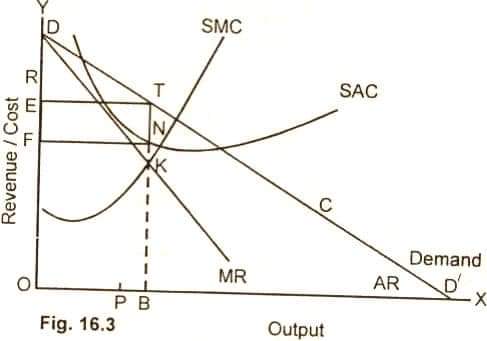
The following is the graph of a Monopoly making Abnormal profit in the short run :
– The short run does not allow the entry of new firms or the exit of existing firms.
● The monopoly has a downward sloping demand curve which is inelastic at the very same time compared to that of the perfect competition.
● In the short period, if the demand for the product is high, a monopolist increase the price and the quantity of output. He can increase the, output by hiring more labor, using more raw material, increasing working hours etc. However, he cannot change his fixed plant and equipment.
● In case, the demand for the product falls, he then decreases the use of variable inputs, (like labor, material etc.).
● As regards the price, the monopolist is a price maker. There is a greater tendency for the monopolist to have a price which earns positive profits. This can only be possible if the price (AR) is higher than average total cost (ATC). The short run profit earned by the monopolist is now explained with the help of the diagram (16.3) below.
● In this diagram, the monopoly firm is in equilibrium at point K where SMC = MR. The short run marginal cost (SMC) curve cuts MR from below.
● At point K both the equilibrium conditions are fulfilled. As a result, therefore, OE is monopoly price and OB, the monopoly output. At the monopoly output OB, the average total cost OF = BN. The profit per unit is FE.
● The short run monopoly profit is ETNF, It is represented by the area of shaded rectangle in figure 16.3 above.
● At the output smaller than OB (say at point P) MR > SMC. Therefore, increased output up to B adds more to total receipts than to total costs. In case, the output is increased beyond OB, the MR < SMC. Hence, the increased outputs beyond OB adds more to total cost than to total receipts. This causes profits to decrease. So the best level of output for the monopolist firm is that where SMC curve cuts the MR curve from below (Optimal Quantity).
CALCULATION OF PROFITS UNDER MONOPOLY
( Please now focus on the second Monopoly Graph in Long Run which is in black ink )
Let’s say you are to calculate the profit for this Monopoly firm, the formulas will be as follows :
Note :
– The cost of the firm is R19 because the turning point or lowest point of AC ( Average Cost ) is at R19.
– The price is R25 which is above R19 ( Cost ) since AR ( Average Revenue ) is above AC. We are bound to comprehend that AR is Price.
– When AR is above AC, the Price is above AC and the firm makes Economic Profit.
– When AR is below AC, the Price is will be below AC and the firm makes a Loss.
– When AR is equal to AC, the price will be equal to AC and the firm makes normal profit or economic profit of zero.
– The optimal quantity is very important when it comes to calculating profits. This is a quantity where MR and MC intersect or should we say it’s a quantity where profit maximization occurs.
According to the second graph this quantity is 100.
So this Monopoly firm is making Economic profit/Supernormal profit/Abnormal profit. The profit will be calculated as follows :
EP = ( P x Q ) – ( C x Q )
Where :
EP is for Economic Profit
P is for Price
Q is for Optimum Quantity
C is for Cost
Calculation
EP = ( P x Q ) – ( C x Q )
EP = ( 25 x 100 ) – ( 19 x 100 )
EP = 2500 – 1900
EP = 600 ← The firm is making an Economic Profit of 600.
ALT FORMULAR
Alternatively we can use the FF formular :
EP = ( P – C ) x Q
Where :
EP is for Economic Profit
P is for Price
Q is for Optimal Quantity
C is for Cost
Calculation :
EP = ( P – C ) x Q
EP = ( 25 – 19 ) x 100
EP = 6 x 100
EP = 600 ← The firm is making an Economic Profit of 600.
THE FEASIBLE ESSAYS UNDER MONOPOLY FOR 2022 TRIAL & FINAL EXAMS
ESSAY 1 : ( 40 Marks )
Body :
• Discuss in detail the characteristics of a monopoly. (26 marks)
Additional Part :
• Evaluate the effects of monopolies on an economy. (10 marks)
ESSAY 2 : ( 40 Marks )
Body :
Discuss the monopoly profits and losses in the short run under the following headings (26 marks) ;
• Economic profit (13)
• Economic loss (13)